When the Reading Outgrows One Chat
A conversation that cross-examined four documents cleanly will eventually quote you a version you retired an hour ago, and nothing has broken.
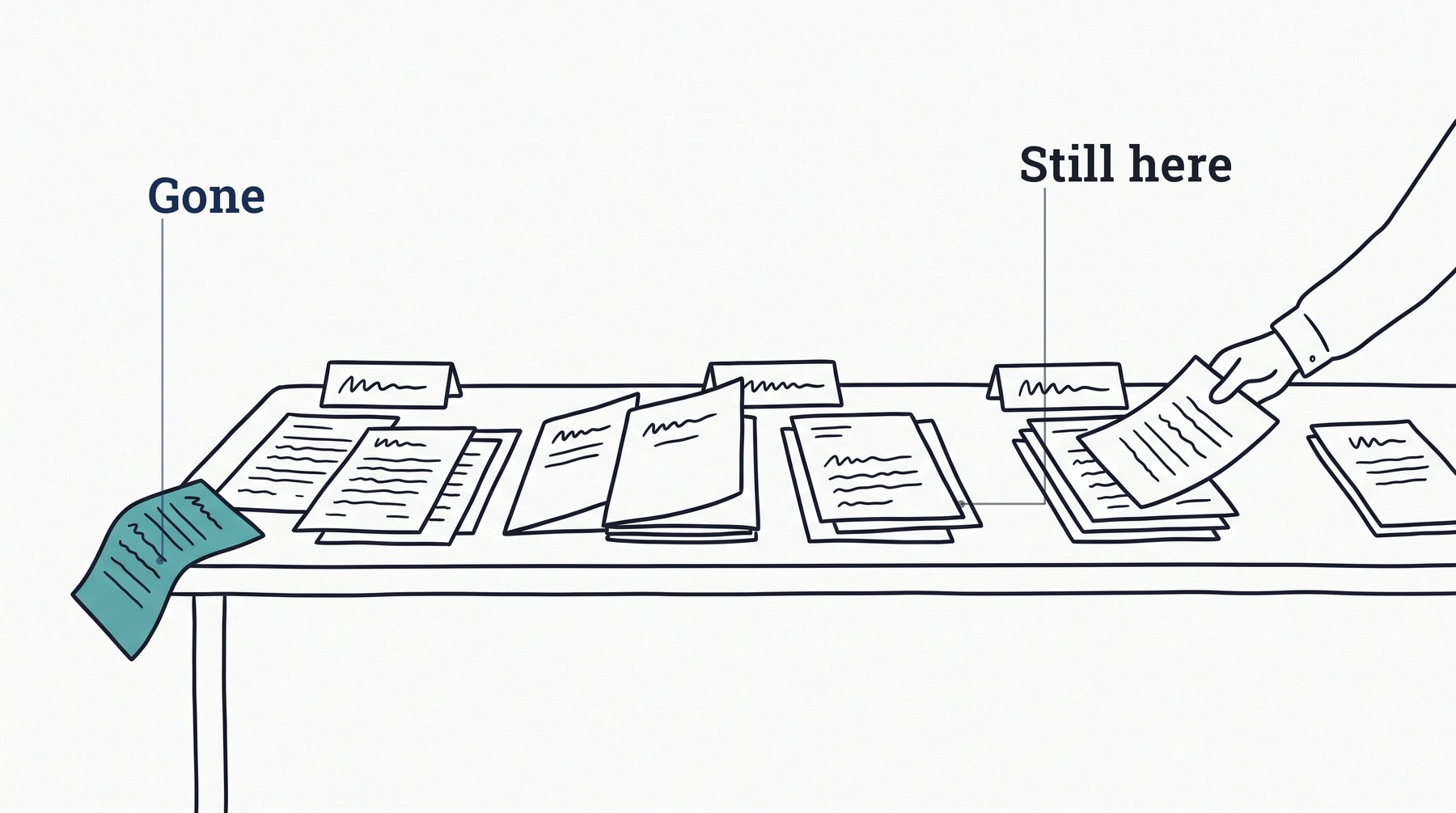
A conversation happens on a workbench, and the bench has edges. Your files sit on it, and so does every question, every answer and every table it built.
The bench is enormous and it is still a bench, which is why a long piece of work eventually crowds it.
What follows is the shape of that failure and the three moves that get you past it.
The bench has edges
A crowded bench fails politely. Nothing crashes, no warning appears anywhere on the screen, and the answers simply get slightly worse.
An old version gets cited instead of the current one. A detail from the report blurs into one from the notes. Something you settled in the first ten minutes comes back answered as though you had never raised it at all.
It reads as the machine getting tired. It is the desk getting full, which is a different problem with a different fix.
Once you can see the bench, the moves are almost obvious, and the first one costs nothing at all.
Hand the work over to yourself
The cheapest move is a new conversation for each job. Extraction in one, the comparison in another, the figure that will not reconcile in a third.
"Attaching the same files again feels wasteful, and it is cheaper than an answer contaminated by the job before it."
Sometimes the job is larger than one conversation however clean it is. A fresh start is not what you want. You want this thinking carried on somewhere with room, so ask Claude to write its own handover and paste what comes back into the next chat.
Run that request at the end of the crowded conversation. What comes back is also a useful audit of whether the work so far holds together.
Paste the brief as the first message and say what it is, so it reads as a starting state rather than as a question.
Put the source documents back beside the brief and ask one question only the brief could answer. A correct answer means the baton landed.
That last step is what separates a durable handoff from a fragile one, because a brief is a compression and compression loses nuance.
Split the stack itself
Certain material cannot share a bench even one job at a time, and a data room or a decade of minutes is exactly that.
One conversation per document, each producing a structured extraction with its quoted lines
One final conversation holding only those extractions, where the cross-cutting questions get asked
The originals kept to hand, because every quoted line still has to be checkable against a real page
One impossible conversation becomes six small ones and a synthesis, which is how committees solved reading at scale a century ago.
How full is it right now
Older parts of a very long conversation may be summarised automatically rather than simply falling off, which is a cushion rather than a plan, so it is worth knowing roughly where you are standing.
A deliberate handoff preserves what you chose. An automatic one guesses, and it guesses without telling you.
Re-attaching the same folder every Monday is the itch a persistent workspace exists to scratch. The harder question is the one nobody asks first: how much of your longest running conversation was ever worth carrying?
The brief carries the thinking and the originals carry the facts, and neither one does the other's job.
Where these facts come from
How much one conversation holds, and the automatic summarising of its older parts, are the publisher's own documentation, read on the day this was written, stated in tokens there and written as pages here. That recall degrades unevenly as a long conversation fills is a published research finding. The share in the panel is yours, from a page count you set. Nothing here is a measured claim about The Training Group.