Make the Stack Answer
What would you actually do with a stack you were told had been read for you, and had no way of testing?
The briefing gave you a map. This lesson is the questioning, and it is three moves wearing the same idea in different clothes.
Make the stack answer, and make every answer carry the line it came from.
None of the three needs new vocabulary, and all three fail in the same place, which is the last section.
Pull the skeleton out
Every dense document has a skeleton inside its prose. The dates, the amounts, the obligations, the deadlines. Agreements bury them in clauses and reports scatter them across sections.
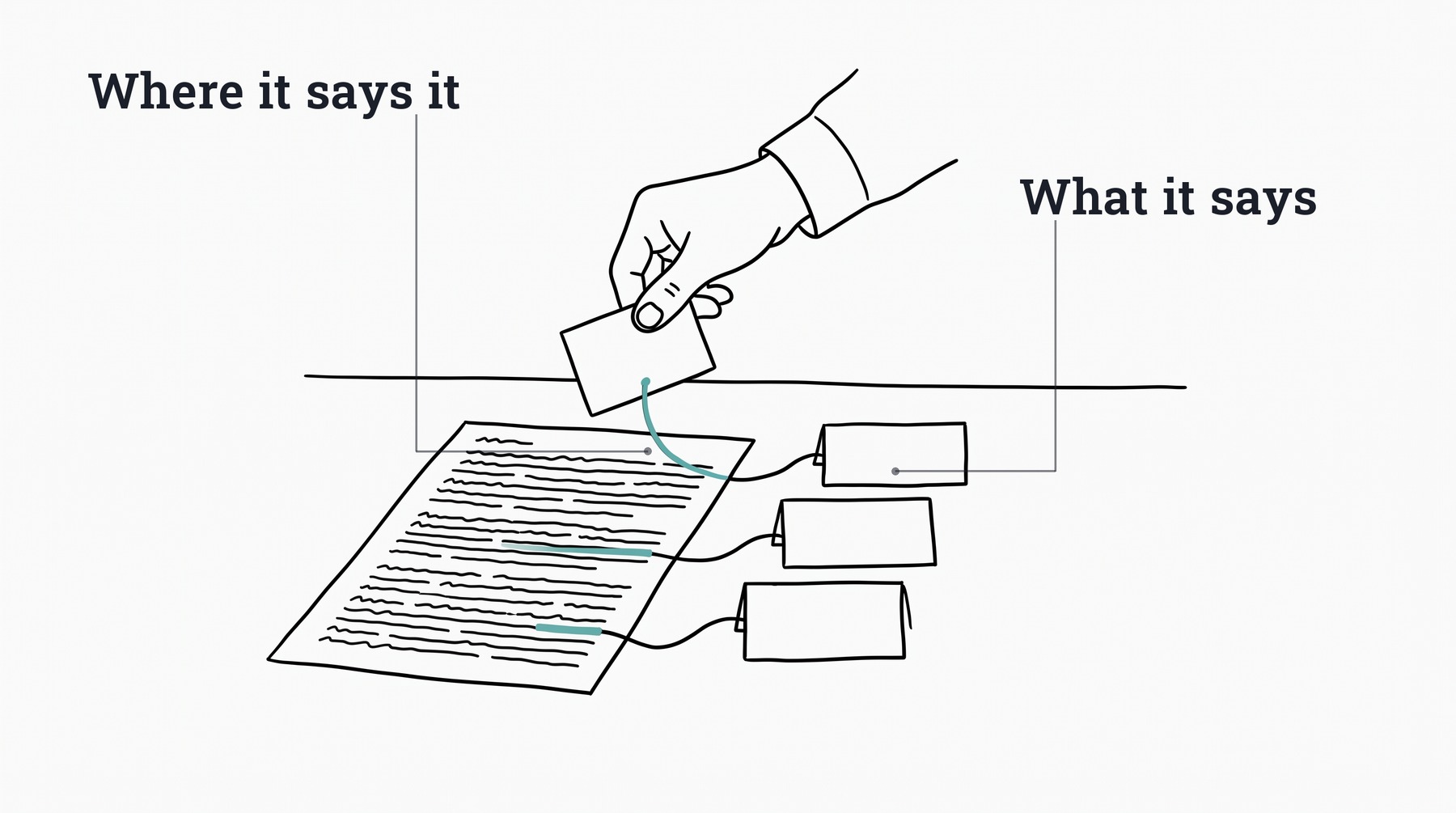
The extraction move lifts that skeleton out and lays it on the table, one row at a time, each row carrying the sentence it came from.
What comes back changes how you hold the document. You stop remembering it. You start looking at it, and any row can be checked against the page in seconds.
The same move works on softer material, so a year of meeting notes gives up every commitment anybody made.
Hold two versions to the light
Comparison is where this stops feeling like a convenience. Attach both versions in one conversation and paste this to Claude:
The last sentence is the professional half. A list of differences is proofreading, and what you want is the consequence of each one.
Most differences in a redrafted agreement are cosmetic, and a few of them move money. Those few surface in under a minute, quoted on both sides.
The third move turns the documents against each other, which is how you find what nobody was looking for.
Set them against each other
Where a report and a spreadsheet disagree about a figure, ask for both numbers quoted with their locations, and for anything else in the stack that would explain the gap. What comes back finds the discrepancy and sources both sides. It does not decide which number is true, which is the one thing it will not do for you.
So the work narrows to something a person settles in one phone call, and the table it leaves behind is checkable in the time the panel just printed.
Where the questioning lies to you
The three moves share one weakness. Hearing it here is cheaper than meeting it on a signature page. Finding, quoting and connecting language is the strong suit. Arithmetic is not.
Quoted lines are checked by opening the page, and each one takes seconds
Counts, sums and percentage changes are treated as drafts until you have recomputed them
Anything that moves money is recomputed in a real spreadsheet with formulas you can inspect
That last one is the clean fix, because a spreadsheet made in the panel carries working formulas rather than a stated total.
Run the extraction move tonight on one document you have already signed, and check three rows against the pages they quote.
Verify what moves money, and let the rest stand on the quoted line.
Where these facts come from
The three moves are this course's own framework rather than anybody's published method. That language models are markedly weaker at multi-step arithmetic than at text analysis is a widely replicated finding, which is why the recompute rule is here at all. The times in the panel are yours: it multiplies a row count you set by fifteen seconds. Nothing here is a measured claim about The Training Group.